



For a local move within Boston or Greater Boston, the moving-day labor and truck for a three-bedroom house commonly requires a planning budget of $2,800 to $5,500. When professional packing, cartons, specialty protection, storage or an additional stop are included, a more realistic full-service budget is often $3,700 to $7,500 or more. A densely furnished property with a full basement, garage and difficult schedule can reach $9,500+.
A house cannot be priced accurately from the three bedroom doors upstairs. The shipment may also occupy a kitchen, dining room, family room, office, attic, basement, garage, shed and outdoor area. These spaces contain many of the heaviest and least visible items: tools, shelving, exercise machines, seasonal bins, patio furniture, bicycles and equipment that requires preparation before it can be transported.
This guide separates the moving-day charge from the complete project cost, explains when one truck is not enough, shows how a four-person crew uses a full day, and covers the closing, storage and property details that are specific to house moves.
Jump to a section:
How Much Should You Budget to Move a 3-Bedroom House?
Practical 2026 budget
Plan approximately $2,800–$5,500 for the core local moving operation with a professional crew and truck. If the company also packs the house, supplies substantial materials or holds the shipment for delayed delivery, the project often lands around $3,700–$7,500+. Large inventories, two trucks, difficult access, specialty items or storage can push the total toward $7,500–$9,500+.
| House-moving profile | Typical plan | Schedule | Planning range |
|---|---|---|---|
| Compact, customer-packed 3BR Limited basement or garage inventory, direct driveway access | 3–4 movers, 1 truck | About 7–10 hours | $2,500–$3,800 |
| Normally furnished single-family home Multiple floors, standard bedrooms and common rooms, moderate storage | 4 movers, 1 large truck | Full day | $2,800–$5,500 |
| Full-service 3BR Professional packing, materials, furniture preparation and local transport | Packing crew + 4 movers | Packing day plus move day | $3,700–$7,500+ |
| High-volume or logistically difficult home Full basement, garage, specialty pieces, storage or two-truck requirement | 4–5 movers, 1–2 trucks | Long day or multi-day | $5,500–$9,500+ |
For comparisons across apartments and other home sizes, start with the complete Boston moving cost guide. Homeowners who are ready to discuss service scope can also review Esquire Moving’s Boston house moving service.
Why 3-Bedroom House Cost Estimates Differ So Much
Online estimates for a local three-bedroom move can differ by several thousand dollars without necessarily describing the same service. One calculator may assume a small customer-packed home, three movers, one truck and six working hours. Another may describe a full house with a basement, four movers, packing, materials and a full-day schedule. Both call the property “three bedrooms,” but the priced work is not comparable.
Apartment-size data is often applied to houses
A three-bedroom apartment usually has fewer secondary storage zones than a detached or semi-detached house. A house may add a second living area, mudroom, utility room, attic, garage, porch and yard. If a price chart does not ask about these spaces, it can understate the shipment before the first box is counted.
Some figures show only hourly moving labor
The advertised total may exclude travel, packing, boxes, specialty handling, storage, an additional truck or an extra stop. It may also assume the customer has already disassembled appropriate furniture and prepared garage equipment. Always identify what the number includes before treating it as a benchmark.
“Local” covers different operating areas
A short move between neighboring Greater Boston towns is not the same schedule as a longer intrastate route. Drive time, tolls, return travel and traffic reduce the portion of the day available for loading and unloading. Companies also use different approved travel calculations.
Household density is not visible in square footage
A recently furnished 1,600-square-foot house may contain less than a long-occupied 1,300-square-foot home with built-in storage, hobbies and family collections. Time at the property often correlates more closely with the number and density of inventory zones than with the real-estate listing.
Estimate the Whole Property, Not Only the Bedrooms
A useful house survey should move systematically from the highest floor to the exterior storage areas. Treat every space as a separate inventory zone. This makes omissions easier to spot and helps the estimator assign packing materials, truck space and crew time.
Zone 01
Bedrooms and Closets
Beds, dressers, wardrobes, linens, clothing, children’s items and under-bed storage.
Zone 02
Living Areas
Sofas, sectionals, media furniture, rugs, lamps, art, books and occasional tables.
Zone 03
Kitchen and Pantry
Breakables, cookware, pantry contents, small appliances and dining pieces.
Zone 04
Office or Flex Rooms
Desks, electronics, files, bookcases, hobby equipment and guest furniture.
Zone 05
Basement and Attic
Seasonal bins, exercise equipment, workshop items, furniture and archive boxes.
Zone 06
Garage and Outdoors
Bicycles, tools, patio sets, planters, sports gear, grill and lawn equipment.
Include built-ins only if they are actually being removed and moved. Identify anything attached to a wall, ceiling, plumbing, gas line or electrical circuit; professional detachment may be required before the moving crew can handle it.
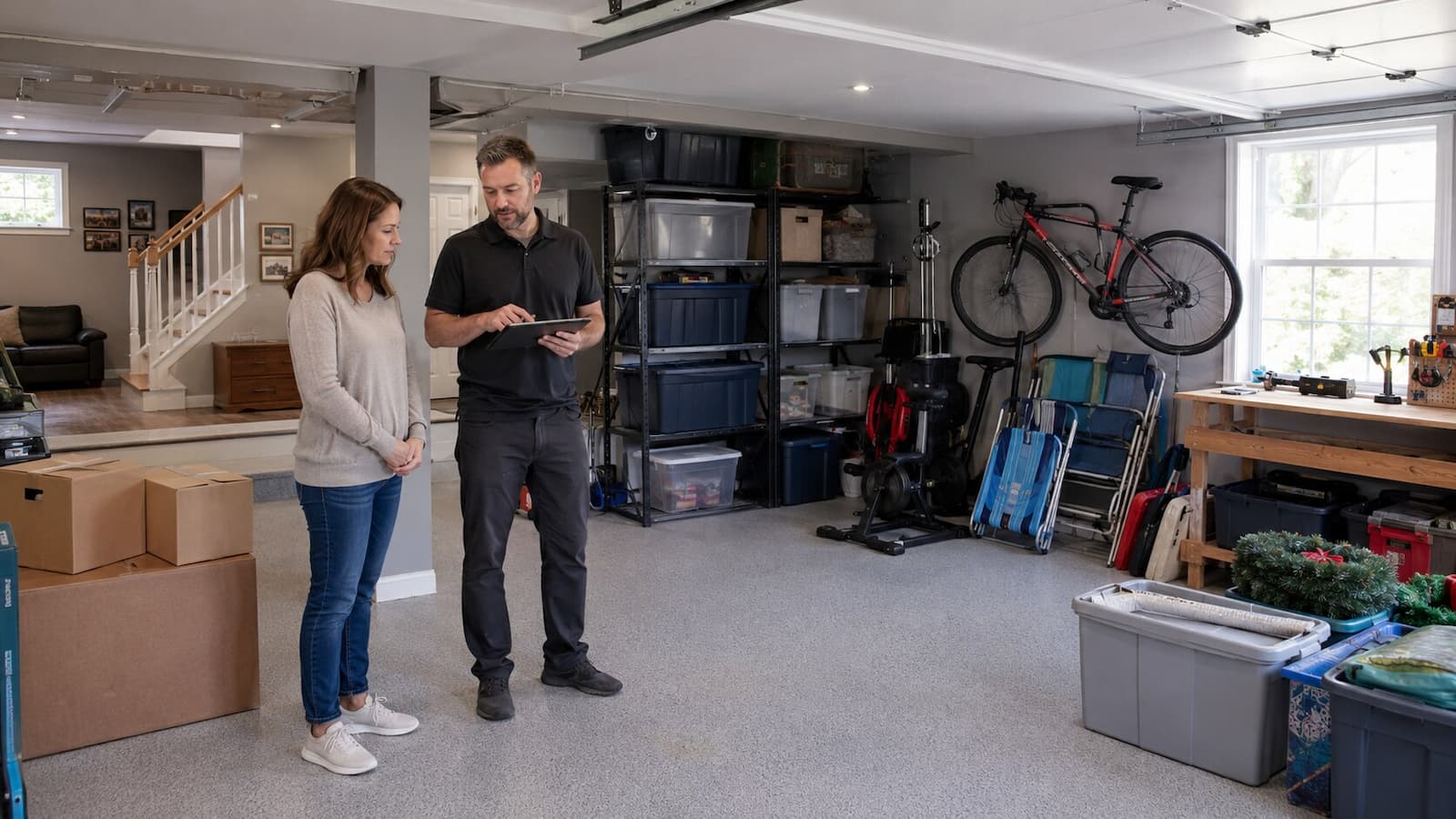
Use a zone count as a reality check
A three-bedroom house commonly has eight to twelve working zones once common rooms and storage spaces are included. If a quote was prepared from three bedrooms, one living room and a kitchen while the property also has a basement, garage and office, the estimate is not yet describing the full job.
Moving-Day Price vs. Total Project Cost
The clearest way to budget a house move is to separate the operational layers. This prevents packing, materials or temporary storage from being mistaken for an unexplained moving surcharge.
| Cost layer | What it may include | Planning range |
|---|---|---|
| Labor and truck | Crew, vehicle, standard equipment, furniture protection, loading, local transport and unloading under the mover’s stated policy | $2,800–$5,500 |
| Packing labor | Full or partial packing, room teams, fragile preparation and carton assembly | $400–$1,500+ |
| Packing materials | Cartons, dish packs, paper, tape, mattress protection and specialty materials | $300–$900+ |
| Storage or additional stop | Overnight hold, delayed delivery, storage handling, donation or secondary destination | $0–$1,000+ |
| Specialty handling | Piano, safe, gym equipment, oversized art, stone furniture or custom crating | Quoted by item and access |
| Optional tip | Voluntary gratuity based on service; normally separate from contracted charges | Customer’s discretion |
Ask for the cost layers in writing
A single total can be useful, but the estimate should still explain the assumed inventory and services. If full packing is included in one quote and excluded from another, the totals should not be compared without adjustment.
How Crew Size and Truck Capacity Affect the Price
Four movers and one appropriately sized truck are a common starting plan for a furnished three-bedroom house. That is not a rule. A compact townhouse may work efficiently with three movers, while a full basement, difficult stair system or large garage may justify five movers or a second truck.
Why four movers can be efficient
A house allows several work zones to operate at the same time. Two movers can protect and move furniture upstairs while another handles boxes from the main floor and a fourth organizes the truck. The crew can also pair safely on large items without stopping all other work.
When a fifth mover is useful
An additional mover can support a long driveway, steep exterior stairs, basement bulkhead, large amount of disassembly or a hard completion deadline. The extra person should have a defined role. Adding labor does not help when a narrow hallway or single small doorway prevents parallel work.
When one truck may not be enough
Truck capacity depends on cubic volume, not just the number of rooms. Bulky but light pieces such as sofas, patio furniture and shelving consume space quickly. Garage and basement contents may add many bins after the household furniture has already filled most of the truck.
A second truck can be more economical than attempting an additional round trip, especially when the destination is distant or access is time-limited. The estimator should explain whether the recommendation is based on volume, weight, route timing or the need to separate specialty items.
| Plan | Best fit | Main benefit | Watch for |
|---|---|---|---|
| 3 movers + 1 truck | Lean townhouse or small customer-packed home | Lower hourly crew rate | Can become a very long day if storage zones were underestimated |
| 4 movers + 1 large truck | Normally furnished three-bedroom single-family home | Multiple floors and loading can progress together | Truck volume must include basement, garage and outdoor items |
| 5 movers + 1 truck | Heavy furniture, difficult stairs, long carries or fixed deadline | More handling capacity and parallel work | Not useful if the route bottleneck allows only one team at a time |
| 4–5 movers + 2 trucks | High-volume property or route where a second trip is impractical | Capacity and loading flexibility | Higher vehicle cost and need for accurate coordination |
Can a 3-Bedroom House Move Be Completed in One Day?
Many local three-bedroom house moves can be loaded, transported and unloaded in one full working day when the home is packed, the truck fits the shipment and access is direct. The plan becomes less reliable when packing remains, the destination keys are not guaranteed, the route is long or several large pieces require technical preparation.
One-day customer-packed move
The crew begins with a walkthrough and property protection, then divides by floor or inventory zone. Furniture is wrapped, appropriate pieces are disassembled, boxes and furniture are loaded, and the shipment travels to the destination for room placement and reassembly. A normal full-day schedule may run eight to twelve hours.
Packing day followed by move day
Separating packing from transport is often better for a fully furnished home. The packing crew can complete the kitchen, art, books, closets and fragile categories without competing with truck loading. The move-day team arrives to a stable inventory and can use daylight, driveway access and key timing more effectively.
Multi-day move with storage or delayed delivery
If the old house must close before the new property is available, the shipment may need an overnight hold or storage period. That changes handling and delivery planning. Items should be packed for storage duration, not merely for a short drive across town.
| Phase | Typical time allocation | House-specific variables |
|---|---|---|
| Walkthrough and protection | 30–60 minutes | Multiple entrances, hardwood floors, stair rails and door protection |
| Furniture preparation and loading | 4–7 hours | Floors, bedrooms, basement, garage, assemblies and truck organization |
| Local travel | 45–120 minutes | Route, traffic, tolls, truck restrictions and additional stops |
| Unloading by room | 3–5 hours | Destination floors, room map, driveway, furniture placement and stairs |
| Reassembly and final review | 45–120 minutes | Beds, dining table, office furniture and requested setup |
How Professional Packing Changes a House-Moving Budget
Packing a house is not simply a larger box count. Different zones need different materials and methods. Kitchens use dish cartons and paper. Artwork and mirrors require surface and edge protection. Garages contain sharp, dirty or mechanical items that cannot share cartons with household goods. Attic and basement contents may need repacking if they have been stored in weak or open containers.

Full packing
The movers pack most agreed household contents, supply materials and label cartons according to the plan. The customer still needs to identify exclusions, personal documents, valuables, medication and items that will travel separately.
Room-based partial packing
A practical compromise is to assign the kitchen, artwork, office electronics or fragile collections to professionals while the household packs clothing, linens and durable items. Define rooms rather than using a vague instruction such as “help with whatever is left.”
Customer packing with a final readiness review
Customers who pack themselves should complete ordinary cartons before move morning. A final video update can show the box count, reveal remaining loose items and allow the mover to adjust the truck or material plan before dispatch.
For full, partial or fragile-only help, review Esquire Moving’s professional packing services.
Unplanned packing can consume the move day
An unpacked kitchen, open attic bins and loose garage tools can add many working hours. If substantial packing remains, scheduling another crew period is often more predictable than expecting the moving team to pack and transport a full house within one closing-day window.
House Areas That Commonly Increase Cost
Basement
Basements often combine furniture, storage and mechanical access. Exercise equipment, workshop benches, freezers and shelving may be heavy or awkward. Bulkhead stairs can help with direct removal, but only if dimensions, slope and exterior access are safe. Photograph every large basement item and both possible routes.
Attic
Attics may have steep stairs, low ceilings and weak storage cartons. Seasonal decorations and archived items are easily omitted from an estimate because they are outside the daily living space. Determine what is moving before the crew arrives; sorting an attic on moving day is slow.
Garage and workshop
Tools should be packed by type and weight. Sharp edges require protection. Fuel-powered equipment usually must be drained and prepared according to company policy. Paint, propane, gasoline, solvents and other hazardous materials may not be accepted. Wall-mounted systems and fixed workbenches may require detachment before moving service.
Outdoor living area
Patio tables, grills, umbrellas, planters, fire pits, hoses and yard tools consume truck space. Soil-filled planters can be extremely heavy and fragile. Confirm which outdoor items the mover can handle, how they must be cleaned or prepared and whether destination placement is included.
Appliances
Washers, dryers, refrigerators and freezers require advance preparation. Moving crews may transport disconnected appliances, but plumbing, gas and electrical disconnection should be assigned to a qualified person when required. Empty and defrost freezers, secure removable parts and confirm the destination hookup plan. For appliance-specific handling, see washer and dryer moving in Boston.
Closing-Day, Key and Storage Logistics
House moves often depend on real-estate timing. The moving crew may be ready to leave the origin while the destination keys are still tied to funding, recording or a final walkthrough. Hourly labor and truck capacity remain committed during that delay.
Do not build a schedule around the earliest possible key release
Ask the closing team for a realistic access window and build contingency into the move plan. If the destination cannot legally be entered, the crew cannot begin unloading. A flexible delivery arrangement may be safer than assuming that paperwork will finish at a precise hour.
Plan the gap between possession dates
If the old property must be vacated before the new one is available, identify whether the shipment needs overnight truck holding, short-term storage or a longer storage period. Each option affects handling, access to belongings and pricing.
Keep closing essentials outside the shipment
Carry identification, contracts, keys, medication, chargers, basic tools, cleaning supplies permitted in your vehicle, children’s essentials and a change of clothes separately. Do not place anything required for the closing or first night into an inaccessible truck load.
For renovation delays, lease gaps and staged deliveries, read the guide to moving household goods into storage in Boston.
What Movers May Refuse to Transport
Policies vary, so request the company’s prohibited-items list before packing the garage, utility room and outdoor areas. Commonly restricted categories include hazardous, flammable, pressurized, corrosive or perishable materials.
- Gasoline, diesel, kerosene and equipment containing fuel
- Propane cylinders and certain pressurized containers
- Paint, solvents, pool chemicals, pesticides and corrosive cleaners
- Fireworks, ammunition or other regulated materials under company policy
- Perishable or open food that cannot tolerate the schedule
- Cash, jewelry, irreplaceable documents and sensitive personal records
- Prescription medication and medical essentials needed immediately
- Pets and, depending on route and conditions, certain live plants
Do not hide restricted materials in cartons. Ask how to dispose of or transport them lawfully. Drain and clean fuel-powered equipment early enough for fumes to dissipate, following the equipment manufacturer’s instructions.
Three Realistic Boston 3-Bedroom House Scenarios
Scenario A: Compact city townhouse
- Three bedrooms on upper floors
- Limited basement storage and no garage
- Customer-packed cartons
- One truck and 3–4 movers
- Short local route with usable curb or driveway access
Planning range: approximately $2,500–$3,800. Stairs still matter, but the shipment remains controlled because secondary storage and outdoor inventory are limited.
Scenario B: Typical Greater Boston single-family home
- Three furnished bedrooms plus living, dining and office areas
- Moderate basement and garage contents
- Four movers and one large truck
- Several furniture assemblies
- Full-day local move with normal driveway access
Moving-day planning range: approximately $2,800–$5,500. Packing and materials are added according to the actual scope.
Scenario C: Established household with packing and storage
- Full basement, garage and outdoor furniture
- Professional kitchen, art and fragile-item packing
- Four or five movers with one or two trucks
- Closing gap requiring an overnight hold or storage
- Heavy exercise equipment or another specialty category
Project planning range: approximately $5,500–$9,500+. The upper portion reflects several service layers, not merely the existence of three bedrooms.
How to Compare Three-Bedroom House Moving Quotes
| Estimate item | What a useful quote should identify | Question to ask |
|---|---|---|
| Property scope | Every floor, room, storage area, garage and outdoor zone | Which spaces were included in the survey? |
| Inventory volume | Furniture, carton range, specialty pieces and equipment | Does the volume support the proposed truck plan? |
| Crew plan | Number of movers, roles and expected duration | Why is this crew size efficient for the property? |
| Vehicle plan | Truck size, second truck or possible additional trip | What happens if the shipment does not fit? |
| Travel treatment | Dispatch, return, mileage, tolls and route between locations | When does billable time start and stop? |
| Packing and materials | Rooms packed, material assumptions and pricing | What remains the homeowner’s responsibility? |
| Access | Driveway, exterior stairs, interior floors and destination route | Were difficult entrances and long carries shown? |
| Closing or storage contingency | Waiting, overnight hold, storage and redelivery terms | What happens if keys are delayed? |
| Protection and contract | Valuation options, bill of lading and change terms | How are added inventory or services documented? |
For a move within Massachusetts, review the mover’s tariff, estimate and bill of lading. The Commonwealth explains these documents in its consumer guide to moving within Massachusetts. If the survey changes after packing, request a written update rather than relying on a verbal assumption.
The guide to why moving quotes change explains how added inventory, revised access, timing and extra stops affect the scope.
How to Control the Final Cost of a House Move
Make keep, sell, donate and dispose decisions by zone
Do not attempt to declutter the entire property as one project. Finish the attic, then the basement, garage and each room. Dense low-value items such as old files, unused tools and damaged flat-pack furniture consume substantial labor and truck capacity.
Stabilize the inventory before selecting the truck plan
Large purchases, inherited furniture and storage-unit contents added after the survey can invalidate the capacity estimate. Provide the mover with the final box range and photographs of new items before dispatch.
Prepare equipment according to policy
Drain fuel, remove propane, clean outdoor equipment and empty appliances as required. If the crew discovers an unprepared mower, grill or freezer, the item may be left behind or require extra time to resolve.
Use a destination floor plan
Mark rooms and decide where major furniture belongs before unloading. The crew should not need to relocate a bed or sectional after it has been assembled. Measure large items against destination doors, stair turns and room dimensions.
Keep the driveway and entrances usable
Move personal vehicles, arrange snow or leaf clearance, trim obvious obstructions and confirm that the truck can use the driveway without blocking required access. At a city address without a driveway, plan legal curb space early.
Schedule cleaning and contractors around the moving operation
A cleaning crew, painter, appliance installer and movers should not compete for the same doors and floors. Give each provider a realistic window, particularly at the destination where furniture placement needs clear rooms.
Choose the date based on capacity, not only rate
A full-house move needs enough daylight, crew availability and schedule margin. A nominally cheaper late start can be poor value if it pushes unloading into overtime, misses a closing window or requires an overnight hold. If timing is flexible, review the lower-cost moving periods in Boston.
How Long-Distance Pricing Differs for a 3-Bedroom House
The local ranges in this article should not be used for an interstate move. Long-distance pricing reflects shipment weight or volume, mileage, route, pickup and delivery access, service level, delivery schedule, packing, valuation options and storage.
A three-bedroom house moved to a nearby state may cost several thousand dollars. A cross-country full-service relocation can reach five figures. The destination matters, but so does whether the shipment uses dedicated or shared transportation and whether delivery requires a smaller shuttle vehicle.
For an interstate quote, provide the same whole-property inventory used for local planning. Ask whether the estimate is binding or non-binding, what could revise it, how delivery timing works, and whether storage-in-transit is included. Esquire Moving’s Boston long-distance moving service explains the route-planning process.
Frequently Asked Questions About Moving a 3-Bedroom House
What is a realistic local cost to move a three-bedroom house in Boston?
The core labor-and-truck operation commonly requires about $2,800–$5,500. A full-service project with professional packing, materials, storage or specialty handling often ranges from approximately $3,700–$7,500+, and a high-volume move can exceed that.
Why do some online calculators show only $1,000–$2,000?
They may assume a smaller customer-packed shipment, fewer working hours and no basement, garage, packing, storage or specialty handling. Check whether the calculator describes a three-bedroom apartment, a compact house or a complete established household.
How many movers are normally needed?
Four movers are a common plan for a normally furnished three-bedroom house. Three may work for a compact home. Five can be efficient for difficult stairs, a long carry, substantial furniture or a strict deadline.
Will one moving truck be enough?
Often, but not always. A large truck may hold a typical shipment, while full basements, garages, patio furniture and bulky pieces can justify two trucks or another transport plan. A video survey helps the mover estimate cubic volume.
How long does the move take?
A local customer-packed move commonly requires a full day of roughly 8–12 hours. High volume, long travel, difficult access, unfinished packing or delayed keys can extend the schedule.
Should professional packing happen on a separate day?
For a fully furnished home, usually yes. A separate packing day protects the move-day schedule and allows the company to confirm final carton volume before loading.
How many boxes does a three-bedroom house need?
There is no reliable bedroom-based number. Many homes produce 70–120+ cartons, but long-term storage, books, kitchen density, children’s items and hobbies can change the count substantially. Estimate by zone and update the mover after packing.
Does a basement increase the cost?
It can. The effect depends on volume, stair access and item type. A few sealed bins add little; a workshop, gym, freezer and stored furniture can change the crew, time and truck plan.
Are garage items included automatically?
Only if they were included in the inventory. Show tools, shelving, bicycles, seasonal bins, lawn equipment and outdoor furniture. Ask which items require draining, cleaning or separate disposal.
Will movers disconnect appliances?
Policies vary, but gas, plumbing and electrical disconnection may require a qualified technician. Movers can often transport appliances after they are safely disconnected, emptied and prepared.
Can movers transport a grill or lawn mower?
Often only after fuel, propane and other restricted materials are removed according to company policy. Clean the equipment and request preparation instructions well before moving day.
Can the move happen on the same day as closing?
Yes, but key release is a major schedule risk. Build contingency into the plan and discuss waiting, overnight holding or storage terms before booking.
What happens if the new house is not ready?
The shipment may need to remain on the truck overnight or enter storage, depending on company policy and availability. Confirm pricing, access and redelivery arrangements before the move.
Does the estimate include packing materials?
Do not assume so. Furniture blankets may be included while cartons, paper, tape, mattress protection and specialty materials are billed separately. Request the material policy in writing.
How much does a long-distance three-bedroom move cost?
Long-distance totals vary widely by destination, shipment size, service type and delivery timing. A regional move may cost several thousand dollars; a cross-country full-service move can reach $10,000 or more. Request a route-specific estimate.
What is the fastest way to improve quote accuracy?
Provide a complete video survey that includes bedrooms, common rooms, closets, basement, attic, garage, outdoor areas, large items and every access route. Follow it with the final box count and any changes before move day.
Bottom Line
A local Boston move for a three-bedroom house commonly requires $2,800–$5,500 for labor and truck service. Once packing, materials, storage, specialty items or two-truck capacity are included, a more complete budget is often $3,700–$7,500+, with complex projects reaching $9,500 or more.
The most accurate estimate treats the house as a collection of working zones rather than three bedrooms. A survey that covers every floor, basement shelf, garage item, outdoor piece, access route and timing constraint gives the mover enough information to choose the right crew, truck and schedule.
Pricing note: Figures shown here are July 2026 budgeting ranges, not promised charges. The written estimate, applicable tariff, final inventory, crew and vehicle plan, packing scope, travel policy, access, moving date, storage and selected services determine the actual price.
Request a Whole-Property Moving Estimate
Share every floor and storage area, the expected carton count, driveway and stair access, appliance preparation, packing needs, destination timing and any storage or additional stops.