Cardio equipment
Treadmills, ellipticals, stationary or recumbent bikes, rowers, and connected fitness machines.
- Console and screen protection
- Deck, pedal, arm, or rail stabilization
- Power and accessory inventory
- Manufacturer move instructions




From a single treadmill in a walk-up to a planned fitness-room relocation, the job starts with the equipment—not a room count. Esquire builds the move around model details, weight, access, protection, and the required setup handoff.
“Gym equipment” is not one category. A connected treadmill, selectorized strength station, and rack of free weights create different handling, access, and technical questions.
Treadmills, ellipticals, stationary or recumbent bikes, rowers, and connected fitness machines.
Benches, racks, plate-loaded machines, cable stations, functional trainers, and multi-gyms.
Dumbbells, plates, kettlebells, barbells, storage trees, mats, and modular rubber flooring.
A machine can fit inside the destination and still fail at a stair turn or elevator door. The survey should connect all three sets of dimensions before crew size and preparation are finalized.
Record assembled dimensions, approximate weight, removable components, balance points, and the smallest configuration allowed by the manufacturer.
Check doors, stair width and landings, ceiling clearance, hallway turns, freight elevators, docks, curb distance, and floor protection needs.
Confirm the placement footprint, operating clearance, power location, ceiling height, floor condition, and whether anchoring or technical commissioning is required.
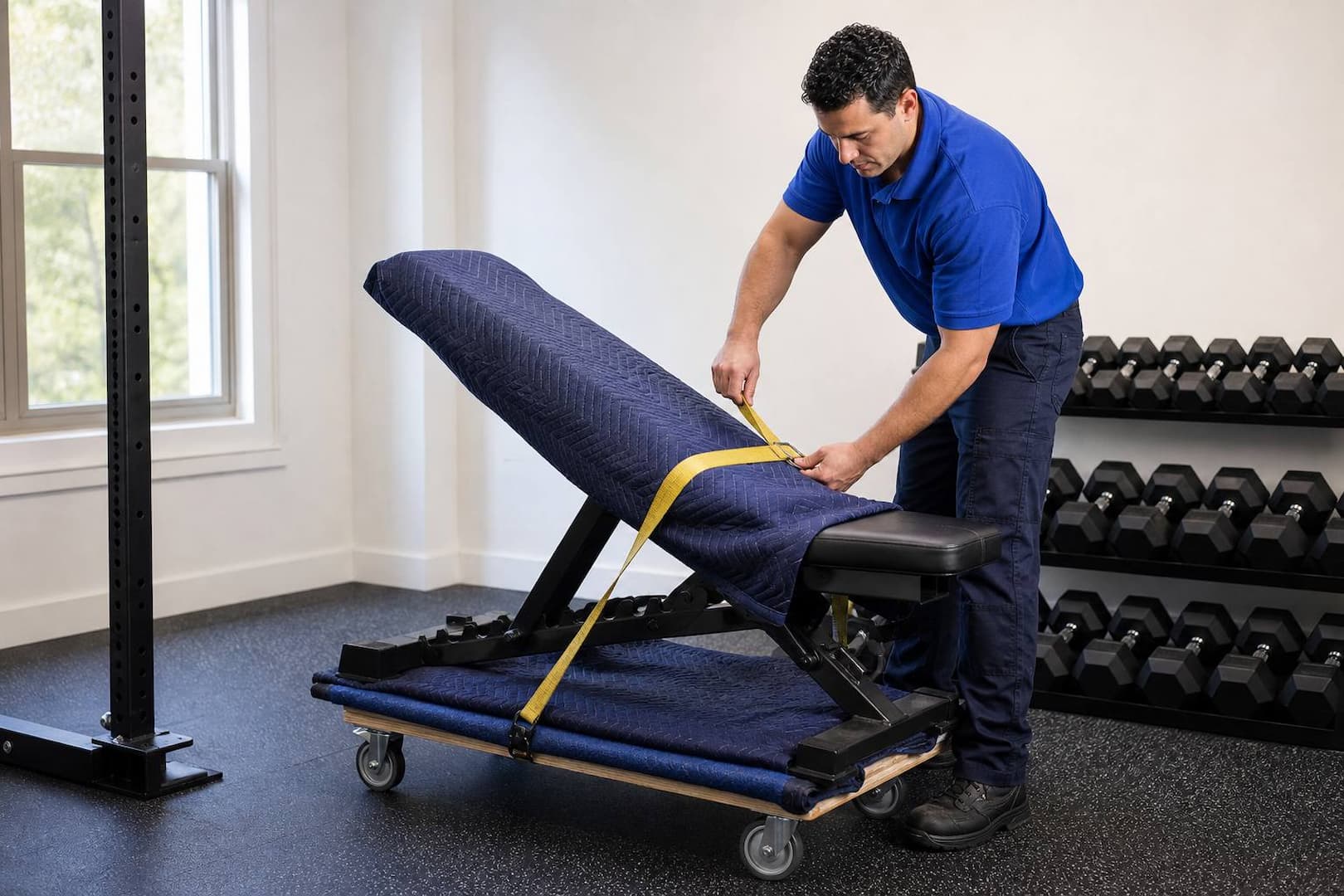
Good protection is specific to the unit. Displays, upholstery, rails, adjustment pins, plates, and loose hardware should not be treated like one blanket-wrapped object.
The physical equipment may overlap, but access, scheduling, documentation, and reopening expectations do not.
Common projects include a treadmill or smart bike, basement gym, garage setup, condo fitness area, marketplace delivery, or equipment moved within the same property.
Studios, apartment amenities, offices, hotels, schools, physical-training spaces, and commercial gyms usually need an itemized sequence and facility contact.
Where curb space is limited, a reserved moving-truck space can reduce carrying distance and uncertainty. The City states that a permit is not mandatory but guarantees a legal spot; review the current process on the official Boston.gov moving-truck page.
Before booking, confirm which tasks fall within the moving scope and which must be completed by the equipment manufacturer, an authorized fitness technician, electrician, or qualified installer.
The estimate should reflect the machine list and the route—not generic bedroom counts or a one-size-fits-all heavy-item price.
Important details for homeowners, facility managers, personal-training studios, apartment communities, and commercial fitness spaces.
Projects may include treadmills, ellipticals, exercise bikes, rowers, benches, racks, free weights, plate-loaded equipment, cable or selectorized machines, and related flooring or storage pieces. Acceptance and preparation depend on the specific model, condition, weight, access, and technical requirements.
It may be possible after the unit and entire route are assessed. Doorways, stair width, landings, ceiling clearance, turns, weight, and the manufacturer's approved disassembly options all affect the plan. Photos and measurements should be provided before crew requirements are confirmed.
Some standard mechanical disassembly and reassembly may be included when reviewed and written into the estimate. Complex cable systems, weight stacks, electronics, hydraulics, anchoring, calibration, warranty-controlled work, or manufacturer-specific commissioning may require a qualified fitness-equipment technician or installer.
Do not place a large quantity of dense weights into ordinary oversized boxes. Keep pairs and sets organized, use appropriately sized containers or handling methods, identify unusually heavy units, and provide the full weight inventory so loading and floor protection can be planned.
Yes, a facility move can be planned around an asset list, floor plans, loading access, freight elevators, building insurance requirements, operating hours, phased downtime, and the technical handoff. Larger projects may require a detailed site review and coordination with equipment technicians.
Cost depends on the number and type of machines, weight and dimensions, access, required crew and handling equipment, protection, disassembly scope, travel distance, additional stops, storage, and any separate technical work. Photos, model numbers, and route details produce a more useful estimate.
Share the inventory, photos, access conditions, timing, and destination layout. Esquire can use those details to define the moving scope and identify any technical handoff before moving day.
Include the equipment list, both addresses, move date, access notes, and required services.